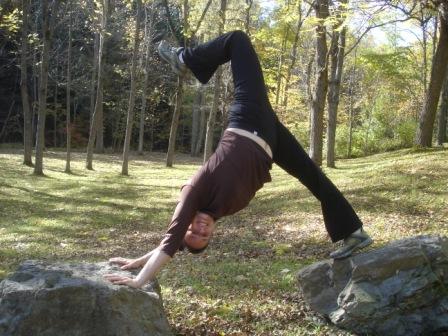
I took this picture a few weeks ago, in Ithaca, NY. These rocks were just irresistable 🙂 I was taking a hike, and stopped to do a quick photoshoot. I want to go outside and practice now!
Posted November 18th, 2008 | 3 Comments » | 
I took this picture a few weeks ago, in Ithaca, NY. These rocks were just irresistable 🙂 I was taking a hike, and stopped to do a quick photoshoot. I want to go outside and practice now!
Posted November 17th, 2008 | 1 Comment » |
My prenatal yoga teacher mentor, Colette Crawford, sends out a monthly newsletter. In this month’s newsletter, she includes a small article about healing from a diastasis (separation of abdominal muscles in pregnancy). Those of you who have taken my postnatal class will find much of the information familiar, but it’s still very helpful to read and hear again.
Here’s her article:
Preventing and Healing from a Diastasis
A diastasis is the separation of the first layer of abdominal muscles called the recti. These muscles overstretch from the growing uterus, and due to the softening hormones of pregnancy can pull away from the dark line below the naval called the linea negra.
A diastasis can also develop during the pushing stage of labor, especially from excessive breath holding during pushing.
To prevent a diastasis during pregnancy:
Healing Poses After the Birth
These poses strengthen the pelvic floor and abdominal muscles, free energy in the pelvis, and improve digestion and elimination.
Agni sara
Lie down, knees bent and feet hip width a part; place your hands on your lower belly. On exhale, contract anal and urethral sphincter (as if you are tying to stop urinating), lower abdominal and upper abdominal muscles, then release upper, lower and pelvic floor as you inhale.
Start with 10 rounds and over a period of a several weeks increase to 20+ rounds. Always do this on an empty stomach. Women should avoid this pose during menstruation.
Side-lying leg lifts
Lie on your right side with your head resting on your arm; bend the left knee bringing the left foot behind your right leg. Inhale lifting the right leg, foot flexed, no more than 12 inches from floor. Exhale extending the right leg away from you and down to the floor. Do this 10 to 20 times. Now bend your right knee and bring it towards the belly and straighten left leg, foot is flexed. Inhale raising the left leg up no more than 2 feet. Exhale, extend the leg out and down to the floor. Do this 10 to 20 times. Change sides.
Stirring the pot
Sit with your legs stretched out and hip-width apart. Interlace your fingers together as if you were holding a big stick. With your arms straight, exhale and bend forward, reach between your feet. Inhale over to the right and draw back as if you were stirring a large pot of soup. Move from the waist. Exhale and bend forward down the middle again. On the inhale swivel to the left and lean back as far as possible. This is one round. Do 5 to 10 rounds.
Posted November 13th, 2008 | 2 Comments » |
I am a big fan of women and families having choices, options and alternatives throughout pregnancy, birth, and childraising. That’s why it’s always bugged me that if the medical establishment had its way, homebirth would be illegal everywhere in the US. It’s already illegal in several states for a midwife to attend a woman in labor at home – see mana.org (Midwives Alliance of North America) for more details. FYI, for those of you in Massachusetts, it is alegal – meaning it is unregulated and there is no law for or against homebirth midwives practicing (although Mass Midwives want to change this and create a bipartisan regulatory board).
It’s heartening to read this front page news in the NYTimes about more women choosing home birth. I think enough information is out there about women not being listened to in some hospital settings, and of the huge number of unnecessary interventions happening these days (I’ve written on this before here).
My sincere question is – if ACOG (the American College of Obstetrics and Gynecology) and the AMA (American Medical Association) really want satisfied customers and good outcomes for healthy and happy babies *and* moms, why don’t they try to support homebirth with the best kind of backup support and communication between midwives and doctors? Instead, doctors are strongly discouraged from developing relationships with homebirth midwives. Why don’t they try to establish a more nurturing atmosphere in the hospital so that more families are satisfied with their hospital birth experiences? Instead, more often than not, women are pressured into following hospital protocol, and aren’t encouraged to question their care on anything – from the easy (do I have to wear a hospital gown – why can’t I give birth in my own clothes?) to the more complicated (why do you induce labor? when do you induce labor? what are the many methods of induction? what if I don’t choose to be induced?).
Finally, it’s all well and good that ACOG says they support births in either a hospital or “accredited birth center on hospital grounds.” But how many birth centers are left these days? We had three in Massachusetts. The Wellesley Birth Center closed abruptly a few years ago. The North Shore Birth Center is about to close as we write (click here to get in on the consumer actions being taken to try and save the birth center). Only the Cambridge Birth Center remains – which fills up months and months in advance. The fact is, the climate exists where birth centers can’t operate freely – the owners/practitioners are scared out of business. It’s only because of the homebirth midwives, who really are tenacious, amazing women who will not be silenced, intimidated or scared, that we still have a national conversation about a family’s rights in the birthing world.
To all my wonderful prenatal and postnatal students, present, past and future: every birth is sacred. On some level, I don’t care how or where someone gives birth (that’s only one part of the whole experience of pregnancy and parenthood). I only care that every mom and family feels respected, cared for, and informed. I am supporting homebirth midwives, birth centers, and all other practitioners who are working for this same right to choose how you will bring your baby into the world.
Posted November 12th, 2008 | 1 Comment » |
Writing yesterday about the science of stretching made me realize I have more to write about on a personal level. For the past 4-5 months, I’ve been “aware” of my left hamstring, right at the origin where the hamstring connects to the sit bone (so, think at the bottom of the buttocks/top of the thigh).
I am extremely flexible – partially, just naturally – and definitely because of a sustained yoga practice for the last 16 years. I’ve never had a yoga injury, really never had any kind of an injury.
Except that I got hit by a car 8 years ago. I was walking in the crosswalk and the damn car hit me! Thankfully, he’d started to slow down, so I wasn’t seriously injured (though, I’m still angry at bad drivers when I’m walking – my “pedestrian rage” is a post for another time though).
At the time of the accident, I didn’t go for treatment – there was nothing really wrong. But over the weeks, I realized my back was sore and it wasn’t going away. After a visit to my regular doctor (useless), lots of chiropractic (marginally helpful), and lots of massage and yoga (tremendously helpful), I was back to normal. Except I could feel a bump on the right sacro-iliac joint – scar tissue that had formed. The bump is still there to this day.
For years, I had no problem. But then I started running, and I kind of overdid it. I did too much too fast (very common when people discover something new and challenging). For the first time in 4 years, I felt my back again. I was surprised – I didn’t think I had anything still in there. I stopped running and it went away. I started running again 6 months later – it came back. This time I’d also just ended a long-term romance and that really seemed to compound the situation. It took longer to sort out my back, and more treatment from bodyworkers. I stopped doing backbends during this period of time, which in retrospect, was a mistake.
Over the 4 years since these recurrences, I’ve felt my back off and on. A flare-up always happened if I got overzealous in physical exercise, or if I had an emotional stress in my life. It’s very interesting. I’ve learned that my back is awesome and strong, and it also tells me what I need to know. And I’ve been lucky that on the painscale, all of this has been pretty minor. I haven’t ever been laid-up in bed, unable to teach or in a lot of pain.
The hamstring is a new manifestation of this old injury. It’s been telling me I’ve been overdoing certain parts of my yoga practice (leg stretches like triangle and straddle – things that typically feel really good) and underdoing other parts (leg strengthening, back bending). Also, a big thing is that I’ve been demonstrating postures too haphazardly in class – just popping into a triangle as I’m talking about a certain aspect of the posture, for example.
I’m consciously learning that I have to use other people to demonstrate. I teach 15 sessions a week – it’s very demanding on my body, and I have to recognize that if this hamstring is going to stop nagging me, I’ve got to let it be when I teach. I’m also realizing that it might help to “admit” this to students in class. It’s hard, because it doesn’t really “hurt.” I’m not really “injured.” I want to demonstrate postures, because it makes it easier to teach. I don’t want to talk about myself, because class is for the students, not for the teacher. But I think I need to treat this as if I am injured, and be honest in order to model how to work with your limits in yoga practice. Otherwise, it feels clear that it’s only going to get worse, not better.
I’ve gotten some good chiropractic to adjust my pelvis. I continue to get massage on it, and self massage (more on this in a later post). I’m working on changing my own practice. Now you can help me by not letting me overdo it in class 🙂
This has gotten long, so I’ll write more in a future post about what I’m doing to help this injury. Lots of you have hamstring or other issues, and I’d like to write more about how to develop a therapeutic yoga session.
Thanks everyone, for helping me with this latest “inquiry” into the power of yoga and the beauty of our body’s messages. Even when they’re messages we’d rather not hear 🙂
Namaste,
Barrett
Posted November 11th, 2008 | 4 Comments » |
This recent NYTimes article really has me thinking. I’ve read lots of debates about stretching – when to do it, how to do it, how much is too much? Though yoga is not stretching, flexibility is one of the things yoga is known for, and a definite physical benefit.
Also, recently someone asked me to comment on their debate website. The topic: Is yoga bad for you? I was kind of shocked that the question was even framed that way, and so I’ve been pondering –
Why is it that yoga works for so many of us, particularly on the physical level?
(I’m also a big proponent of how good and necessary yoga is mentally, but for this post, I’m talking the physical benefits).
The crux of the article discusses the difference between static stretching – reaching to hold your toes, for example, and staying in the stretch, unmoving for a period of time – and dynamic stretching. Dynamic stretching is when you move and stretch. Studies have shown that practicing static stretches before exercise or sports weakens the muscles – not a good idea when you want those muscles strong. Dynamic stretching, on the other hand, seems to warm them up and help them work better for the workout ahead.
These dynamic stretches seem to be a lot like the beginning part of a vinyasa yoga class. I think about the sun salutes – how they’re active and even lift some people’s heart rate even though we’re consciously breathing slowly. And for those of you in my class, you know that we practice a lot of back and forth warmup movements with our breath at the beginning of the class.
It’s important to note that this article doesn’t say static stretching is bad – rather, it’s good after a workout, for a cool down. So, it makes sense that we save the longer asana holds for the end of yoga class.
Again, I’m trying to relate what this article imparts about stretching with our yoga class to understand better why people find yoga so useful. However, I’m also interested because many people ask me how to incorporate yoga into their workouts, and into their life. And I’m also interested because yoga injuries aren’t uncommon, unfortunately. And finally, I do live and teach in Boston, a very scientifically-oriented city, and people like to have “proof” that things work. Including me, I guess.
What do you think? Do you use yoga before or after you go for a run (or other physical exercise)? Do you think it’s good to combine yoga and other activities, or is it better on its own?
I’ll keep thinking about this as well – off to practice some dynamic stretches!
Namaste,
Barrett
Posted November 6th, 2008 | 2 Comments » |
Sometimes I need to kickstart a sluggish practice. Like today – I didn’t have a lot of time to practice, so I did what I know always works. I put on some of my favorite yoga music (I have it set as a playlist), and just danced my way through some of my favorite yoga poses.
I really rely on a couple key things to get me in yoga mode – and music is one of them. Some of my favorites are: Krishna Das, Wah!, Deva Premal, music compilations by Shiva Rea, and world music that isn’t yoga specific.
Now that it isn’t so hot outside (and it gets dark quickly), the other thing that can really make my practice meaningful is to light a candle before practice. Not only is it visually stimulating, but can also smell great (if you have an essential oil candle or diffuser). Scents matter – in the summer when I don’t want to light a candle I spray a natural air freshener with essential oils – I like stimulating lemon! Today I used soothing lavender essential oil in my diffuser. Candle lighting is a time-tested ritual for creating a meaningful moment. Almost always I’ll light a candle for someone – often some of my students. Today when I lit a candle, it was for a friend travelling into town and staying with me later tonight.
How do you make your practice meaningful? I encourage you to think outside of the box of your yoga mat to find a way to make some moments today that you’ll remember.
Namaste,
Barrett
Posted November 4th, 2008 | 2 Comments » |
It’s already happened a few times to me as the temperature drops and the days have less light. I am starting to want to hibernate – to move less and burrow into the couch or under the covers.
It’s exactly what I know I’m not supposed to do. I feel so much better when I exercise, when I practice yoga, when I walk outside instead of drive. So this year, as I have in some previous years, I’m telling everyone I can to help me keep moving, and to keep moving themselves.
Recently, the NYTimes wrote this article about all the ways you can fit exercise into your life. The recommendation is for adults to try to get 150 minutes of exercise in a week. That sounds like a lot, but for all of you who live in this great walking city of Cambridge/Boston (or someplace like it), you probably walk for 20-30 minutes many days of the week. You may be getting close to 150 minutes just on your commute around town.
In yoga class this winter, expect lots of flow back and forth between postures, lots of backbends, and lots of energizing pranayama!
Posted October 30th, 2008 | 2 Comments » |
I was so happy to find out that Whole Foods on Prospect St. in Cambridge has a compost bin. This year I didn’t compost much at my CSA farm, but I really think it’s an effective way to reduce waste and promote local farming.
Read this article about Whole Foods’ composting in Cambridge.
Anyway, I’ve been collecting my scraps for a few days, and excited to go over there soon and “contribute” to the pile.
In general, I’m a huge fan of fresh, local food. In my journey through the blogosphere recently, my friend (and yogini) Zeenat turned me on to this blog called bostonlocalvores. Stay tuned for a blog post about evil MSG and all the things it is lurking in.
Namaste,
Barrett
Posted October 29th, 2008 | 3 Comments » |
One of my favorite classes all week is my Postpartum class on Thursday mornings. All the moms I’ve grown close to in Prenatal class suddenly disappear once they have their babies. Over the past year that I’ve been teaching this postpartum class, I’ve been able to stay in better touch with my students and continue to observe and support their entry into parenthood (even if they’re already parents to older children). Plus I get to hang out with cute babies 🙂
New parenthood is hard! Most of my students are smart, organized professionals who have a fair amount of resources, and still they can really struggle with the first few months postpartum. Not only do babies require a lot, but so do moms – proper physical exercise after carrying a baby for 40-some weeks, nourishment for supporting feeding a baby, learning to cope with a new sleep pattern, figuring out a new work/social schedule, etc.
So, anytime a new resource comes up that can help new moms, I’m all about promoting it. My dear friend Christi Collins has written a fantastically practical and super helpful Ebook called “How to Eat to Survive Motherhood.”
I learned a lot by reading it, some of which I’m excited to impart to my students – for example, what the most important nutritional needs are in the postpartum period, and practical foods to have on hand for those needs.
But if you are a new mom, or looking to help out a friend who is a new parent, I highly recommend you buy this Ebook. This Ebook has recipes and worksheets that I think will take the important informational content and make it actionable.
Check out Christi’s site here to buy the Ebook. Even if you’re a new mom who has it pretty together, this book will help you feel even better. And I can’t emphasize enough, that if you’re a friend of new parents, please consider giving something other than a cute outfit for the baby. I know it’s fun to pick out those things, but parents really need a good home-cooked meal, or a massage, or a yoga class, or an afternoon of babysitting or help with chores. This Ebook could be the perfect gift.
Also, my new mom’s class is Thursday mornings from 10-11:15 at Black Lotus for any mom. You are welcome to bring babies up to crawling (usually 6-7 months).
Namaste,
Barrett
Posted October 28th, 2008 | Leave a comment » |
I’ve been reading up on Pranayama as well, particularly enjoying Richard Rosen’s Pranayama: Beyond the Fundamentals, and my all-time favorite, Donna Farhi’s The Breathing Book. In her book, Farhi writes:
“Breathing is the most readily accessible resource you have for creating and sustaining your vital energy…The process of breathing is the most accurate metaphor we have for the way that we personally approach life, how we live our lives, and how we react to the inevitable changes that life brings us.”
I think it’s true. I’m feeling it in my practice every day. Revisiting my experiences over the past year with scuba diving (see yesterday’s post) reminded me of how much my breath mirrors my life.
If you’re interested in the workshop this weekend, it’s at Black Lotus in Cambridge, MA on Sunday November 2, from 1-3pm.
Namaste,
Barrett
 RSS Feed